Why Your Wisconsin Service Area Pages Aren’t Showing Up in Nearby Towns
Why Your Wisconsin Service Area Pages Aren’t Showing Up in Nearby Towns
You’ve done everything by the book. You’re a top-rated contractor in Madison, your Google Business Profile (GBP) is verified, and you’ve spent hours crafting “Service Area Pages” for Sun Prairie, Middleton, and Fitchburg. Yet, when a homeowner in Sun Prairie searches for your services, you’re nowhere to be found. It’s as if an invisible border exists at the city limits, a digital wall that your business simply cannot scale.
I’ve seen this story play out hundreds of times. As someone who survived the dot-com boom and the subsequent bust, I’ve learned that the “build it and they will come” philosophy died in 2001. In the world of google business profile seo, proximity is a jealous god. Many Wisconsin business owners operate under the misconception that a Service Area Page (SAP) is a magic wand. In reality, an SAP is merely an extension of your Google Business Profile – a bridge designed to carry your relevance from your physical office to the surrounding neighborhoods. If that bridge isn’t engineered correctly, it collapses under the weight of Google’s algorithm.
Google’s local search algorithm is built on three pillars: Distance, Relevance, and Prominence. Most businesses fail because they only focus on a fraction of one pillar. They think adding “Sun Prairie” to a page title satisfies the “Relevance” requirement, while completely ignoring how “Distance” and “Prominence” interact to filter them out of the Map Pack. To rank in 2026, you have to understand that google business profile seo is no longer about just “being there”; it’s about proving to Google that you are the most authoritative answer for a specific micro-location.
The Proximity Paradox: Why Distance Often Wins
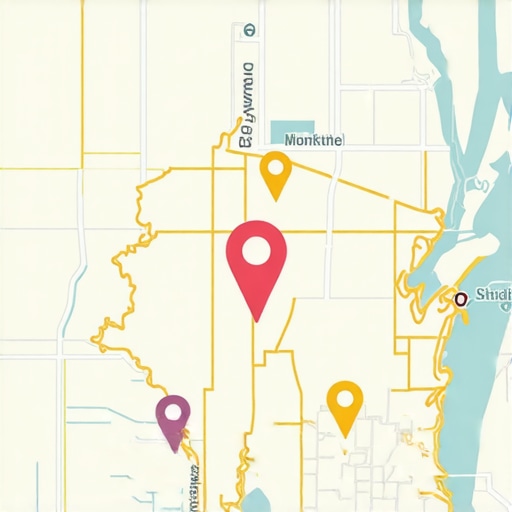
The single most influential factor in local search is the “Distance” or proximity factor. It is the hardest hurdle to clear. If you are a plumber based in the Marquette neighborhood of Madison, Google naturally wants to show you to people in the Marquette neighborhood. However, the moment a searcher moves three blocks away, the competitive landscape shifts. This is what we call the Proximity Paradox.
As the density of local competitors increases, the amount of “map” you are visible in decreases. In a densely populated area like Dane County, Google has an abundance of choices. If there are five qualified plumbers physically located in Sun Prairie, Google has very little incentive to show a plumber located in West Madison to a Sun Prairie searcher. This is Why Your Madison Storefront Disappears the Moment Customers Drive Three Blocks Away. The algorithm is designed to provide the most convenient result for the user, and “convenient” usually means “closest.”
To break this proximity filter, your service area pages must work twice as hard. You aren’t just competing on service quality; you are competing against the physical reality of geography. If your website doesn’t explicitly bridge the gap between your physical location and the target town with high-level technical signals, the “Distance” factor will win every single time. This is why The Service Area Error Quietly Killing Your Madison Lead Flow is often a failure to account for competitor density in adjacent towns.
Relevance: The Role of Hyperlocal Content
If Distance is the hurdle, Relevance is the fuel that helps you clear it. Google pulls data from your website to confirm that you actually serve a specific town. If you don’t have a dedicated, high-quality page for “HVAC Repair in Middleton,” Google has no relevance signal to justify ranking you there over a local Middleton shop. But here is where most Wisconsin businesses get it wrong: they use “cookie-cutter” pages.
You cannot simply take your Madison page, hit “Find and Replace,” and swap “Madison” for “Fitchburg.” Google’s AI is sophisticated enough to recognize thin, templated content. To establish true relevance, you need hyperlocal context. This means mentioning local landmarks like the Fitchburg Public Library or the Badger State Trail. It means discussing specific neighborhood nuances – perhaps the older Victorian homes in a certain part of town that require specialized electrical work, or the unique soil conditions in the Driftless Area that affect basement waterproofing.
When you learn How to Write Service Area Pages That Actually Rank for Madison Neighborhoods, you realize that relevance is about local expertise. Mentioning “winterizing pipes for Wisconsin freezes” is good, but mentioning how you’ve helped residents near Lake Mendota deal with specific humidity issues is better. This level of detail signals to Google that you aren’t just a business that *wants* leads from that town; you are a business that is *active* in that town. This is the core of google business profile optimization – feeding the algorithm the specific, localized data points it craves to verify your service area claims.
The Technical “Why”: Site Speed and Schema
Even with great content and authority, technical barriers can keep your service area pages in the dark. Two of the most overlooked factors are page speed and Local Business Schema. In a recent case study involving a medical clinic in Wisconsin, we found that boosting mobile site speed from a 45 to a 100 score on PageSpeed Insights directly correlated with a 30% increase in “near me” search appearances. Google prioritizes user experience; if your Fitchburg page takes five seconds to load on a mobile device at a job site, you won’t rank.
Then there is the “Hidden Schema Move.” Schema markup is a specialized code that tells search engines exactly what your data means. For Service Area Businesses, you need to use specific `serviceArea` and `areaServed` properties within your `LocalBusiness` or `ProfessionalService` schema. This is The Hidden Schema Move That Puts Madison Shops Above National Chains. It provides a machine-readable map of where you operate, removing any ambiguity for Google’s crawlers.
Remember, as a Service Area Business, you do not need a physical storefront to rank in the Map Pack, but you do need a robust technical foundation. You must ensure that your website acts as a high-performance engine for your GBP. If your technical SEO is lagging, all the hyperlocal content in the world won’t save you. You need to rank google business profile assets by ensuring the underlying code is as sharp as your service.
2026 Trends: AI Search and Local Intent
As we look toward 2026, the landscape is shifting again. We are moving away from the traditional “list of ten blue links” toward AI-driven search experiences and more sophisticated Map Packs. AI search results are increasingly prioritizing “intent” over simple keyword matching. This means that if someone searches for “emergency furnace repair near me” during a February blizzard in Madison, the AI is looking for businesses that have recently posted updates about emergency availability or have reviews mentioning fast response times during cold snaps.
To stay ahead, you must implement 3 Wisconsin GMB Signals to Dominate Local Search in 2026. These include active GBP posting with geo-tagged images, responding to every review with localized keywords, and utilizing “Google Questions and Answers” to address town-specific concerns. Hyperlocal targeting is no longer a luxury; it is the baseline for survival. The businesses that dominate in 2026 will be those that treat their service area pages not as static brochures, but as living extensions of their local reputation.
The shift toward “near me” searches means that Google is getting better at identifying where a user is standing. If your pages aren’t optimized for these hyperlocal intent signals, you’ll find yourself losing market share to smaller, more agile competitors who have mastered the art of geo-targeting. The goal is to be the “obvious” choice for the algorithm, regardless of which side of the Madison beltline the searcher is on.
Conclusion & Action Plan
Your Wisconsin service area pages are failing not because you aren’t a great business, but because you aren’t speaking the algorithm’s language. To rank in Sun Prairie, Middleton, or Fitchburg, you must address the Distance, Relevance, and Prominence trio with surgical precision. Stop using generic templates, fix your technical schema, and start building local authority through genuine community engagement.
Your first step should be a comprehensive audit. Use a google business profile audit tool to identify where your signals are weak. From there, begin building out hyperlocal content that reflects the reality of serving Wisconsin homeowners. The digital border is real, but with the right strategy, it is entirely permeable. Don’t let your competitors own the neighboring towns – start claiming your territory today.
Ready to dominate? Explore how Rank in Madison Neighborhoods Without a Storefront [2026] and The Specific Way Madison Shops Beat Big Box Search Results can transform your local visibility.