
The Exact Method for Looking Inside a Madison Competitor’s Local SEO Strategy
The Exact Method for Looking Inside a Madison Competitor’s Local SEO Strategy
You’ve seen it happen. You’re sitting at a coffee shop on State Street or maybe grabbing a brat at the Terrace, and you decide to check the search results for your industry. You know your business is the best in Dane County. You have the best equipment, the most experienced staff, and a track record of serving Madisonians for years. Yet, when you search for your primary service, there they are: your competitors, sitting comfortably in the top three spots of the Google Map Pack, while your business is buried on page two or three.
It’s frustrating. It feels like the digital version of someone setting up a rival shop right in front of the Capitol and siphoning off every person who walks by. In Madison’s hyper-local market, generic SEO advice – the kind written by people who have never even heard of the Isthmus – simply doesn’t cut it. To win here, you need to stop guessing and start investigating. You need to know exactly why Google thinks your competitor in Middleton or Monona is more relevant than you.
This is where “Reverse Engineering” comes in. At Madison Local SEO, we don’t believe in “magic” rankings. We believe in data. The Google algorithm for local search is built on three pillars: Proximity, Relevance, and Prominence. If a competitor is outranking you, it’s because they are winning in at least two of those categories. This guide will show you the exact tactical method we use to look “under the hood” of a competitor’s google business profile seo strategy to see what they’re doing right – and how you can do it better.
If you’re wondering why your current efforts aren’t moving the needle, it might be time to look at Why Your Madison Shop is Invisible on Google Maps and How to Show Up Again. But today, we are going on the offensive.
Identifying Your “Search” Rivals vs. “Business” Rivals
The first mistake most Madison business owners make is assuming their biggest business competitor is also their biggest SEO competitor. You might have a friendly (or not-so-friendly) rivalry with a shop down the road in Fitchburg, but that doesn’t mean they are the ones stealing your digital leads. In the world of rank google business profile tactics, your “search rivals” are the ones who consistently appear in the Map Pack across multiple neighborhoods.
To identify your true search rivals, you need to perform searches from different locations. Google’s results change based on where the user is standing. A search for “Madison HVAC” conducted from Camp Randall will look very different from a search conducted in Sun Prairie. To truly understand local map pack seo, you need to identify who is “sticky” – the businesses that stay in the top 3 regardless of whether the searcher is in Shorewood Hills or the East Side.
Open an incognito window and search for your primary keyword + “Madison.” Note the top three. Now, try “Keyword + Middleton” or “Keyword + Verona.” Are the same names popping up? Those are your real targets. They have achieved a level of “Prominence” that overrides “Proximity.” Once you have your list of 3-5 top search rivals, it’s time to perform a technical audit to see how they are managing their google maps ranking service strategy.
For more on how these rankings shift, check out How to Stop Madison Competitors From Stealing Your Local Map Leads.
The GBP “X-Ray”: Auditing Categories and Attributes
The core of any local strategy is the Google Business Profile (GBP). But what you see on the surface – the photos, the address, the phone number – is only half the story. The real “engine” of a profile is the category selection. Google allows one primary category and up to nine secondary categories. If a competitor is outranking you, there is a very high probability they have optimized their categories more effectively.
Many Madison businesses miss out on leads because they use a primary category that is too broad or, conversely, too narrow. To see a competitor’s hidden categories, you can use a google business profile audit tool. If you want to do it manually, you can view the page source of their listing on Google Maps and search for their “GCID” (Category ID). This technical tip allows you to see exactly which labels Google has attached to their business behind the scenes.
For example, a law firm near the Dane County Courthouse might have “Personal Injury Attorney” as their primary category, but they might also be ranking for “Trial Attorney” or “Legal Services” as secondary categories. If you only have one category listed, you are fighting with one hand tied behind your back. Proper google business profile optimization requires aligning your categories with what the top-ranking competitors are using, provided they accurately describe your business.
Beyond categories, look at their “Attributes.” Are they highlighting “Women-owned,” “Veteran-led,” or “Wheelchair accessible”? Google uses these attributes to match specific user queries. If your competitor has these filled out and you don’t, they are winning the “Relevance” battle. This is a key part of any gmb ranking service we provide at Madison Local SEO. For a deeper dive into these technicalities, see our guide on 3 Wisconsin GMB Audit Steps to Fix Poor 2026 Map Exposure.
The Geo-Grid Analysis: Mapping the “Proximity Gap”
Proximity is the most powerful – and most frustrating – ranking factor. You might rank #1 when you are standing in your office on Odana Road, but as soon as you drive toward the Beltline, you drop to #5. By the time you reach Monona, you’re invisible. This is the “Proximity Gap.”
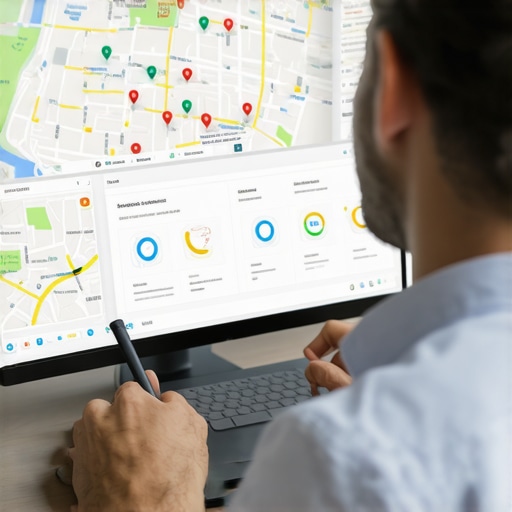
To look inside a competitor’s strategy, you need to see their “Geo-Grid.” A google maps rank tracker allows you to visualize rankings across a map. It places a grid of pins over Madison and tells you exactly where a business ranks at each point. When you run this for a competitor, you can see their “radius of influence.”
If a competitor in McFarland is ranking well in downtown Madison, they have successfully built enough “Prominence” (through backlinks and reviews) to overcome the distance. If you see their ranking drop off sharply at a specific neighborhood boundary, that’s your opening. You can target those “weak” zones with hyper-local content. We often see businesses that rank perfectly in the suburbs but fail in the city center. Understanding this data is the first step to expanding your reach. This is often why Your Madison Storefront Disappears the Moment Customers Drive Three Blocks Away.
Reverse-Engineering Review Velocity and Sentiment
Everyone knows reviews are important, but most people focus on the wrong thing: the total number. While having 500 reviews is great, Google cares more about “Review Velocity” and “Review Sentiment.”
Look at your top Madison competitor. How many reviews have they received in the last 30 days? If they are getting 5 new reviews a week and you are getting one a month, Google sees them as more “active” and relevant. This is a core component of a modern google review strategy. Furthermore, look at the words used in those reviews. If customers are constantly mentioning “best plumber in Madison” or “emergency furnace repair in Dane County,” Google’s AI associates those keywords with that business.
Are your competitors using a specific “text move” to get these reviews? Often, top-ranking businesses have a system – a follow-up text or an email – that encourages customers to use specific service keywords. If you want to rank higher on google maps, you need to match their velocity and surpass their keyword density in reviews. Don’t just ask for a review; ask for a review that mentions the specific service you provided.
Content and Hyper-Local Signals
The final piece of the puzzle is what happens off the Map Pack but on the competitor’s website. Google looks at your website to verify the information on your GBP. If a competitor is outranking you, look at their “Service Area” pages. Do they have dedicated pages for “SEO for Madison Neighborhoods” or “HVAC Services in Nakoma”?
Hyper-local signals are the “secret sauce” for 2026. This includes mentioning local landmarks like the Kohl Center or the Vilas Zoo in your website copy and GBP posts. Speaking of GBP posts, are your competitors using them? Many businesses treat these like social media – posting once and forgetting it. But the pros use them as SEO tools, packing them with keywords and geo-tagged images. If you want to beat them, you have to Stop Treating GMB Posts Like Social Media if You Want to Rank in Wisconsin.
Check if they are using local seo tools to automate these posts or if they are manually crafting them to include local events. This level of detail tells Google that the business is an integral part of the Madison community, which boosts the “Prominence” score significantly. This is The Specific Way Madison Shops Beat Big Box Search Results; they lean into being local in a way a national chain never can.
Conclusion: Turning Intelligence into Action
Reverse-engineering a competitor isn’t about copying them; it’s about finding the gaps in their strategy and filling them. By auditing their categories, mapping their proximity, and analyzing their review velocity, you gain a roadmap for your own growth. You can see exactly what Google is rewarding in the Madison market right now.
The local algorithm is constantly evolving, with “Relevance, Proximity, and Prominence” remaining the core pillars. Whether you are a lawyer near the Capitol or a contractor in Sun Prairie, these tactics work. If you find this process overwhelming, it might be time to consult a google maps ranking service or invest in high-quality local seo software to do the heavy lifting for you.
Don’t let your competitors own the Madison market. Use these steps to audit your profile today, or reach out to us at Madison Local SEO to handle the technical deep dive for you. The leads are out there – make sure they’re finding you, not the guy down the street.